
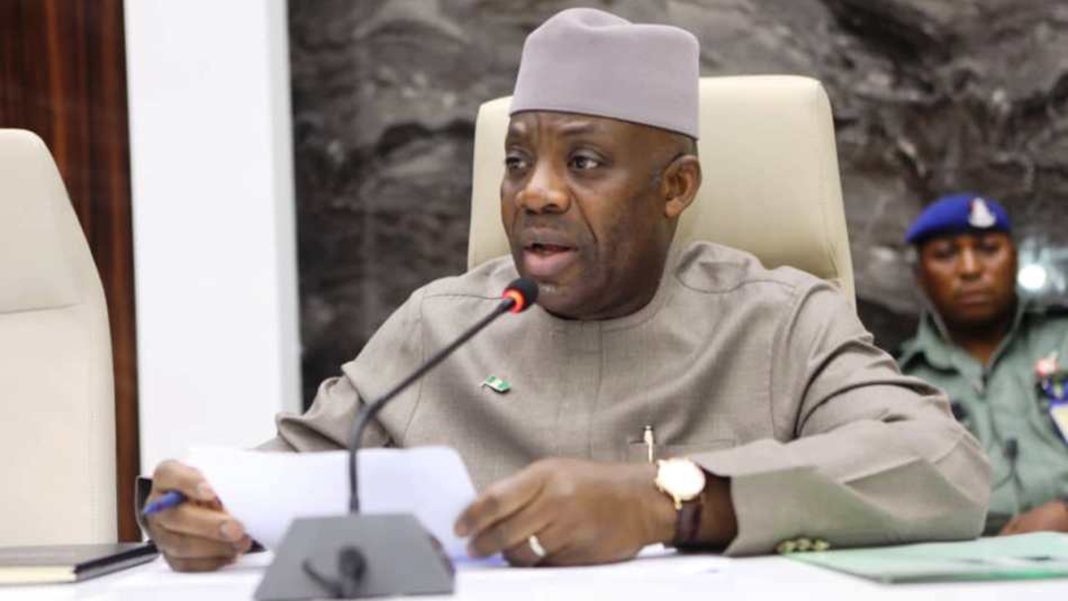

The Minister of Education, Dr. Tunji Alausa, has urged state governments to meet the conditions required to access the $552 million World Bank-supported Hope for Quality Basic Education for All (HOPE-EDU) programme, warning that delays in fulfilling key obligations could prevent states from benefiting from the performance-based funding initiative.
Alausa made the call on Tuesday while declaring open a five-day executive retreat for Commissioners of Education, organised by the Committee of States’ Commissioners of Education (COSCEN) in Abuja.
States Yet to Meet Funding Requirements
The minister noted that although all 36 states are eligible to participate in the programme, several have yet to complete critical requirements necessary for accessing the funds.
According to a statement issued by Ikharo Attah, Special Adviser on Media and Communications to the Minister, some states are yet to sign the required Subsidiary Loan Agreements (SLAs), open designated programme accounts, and comply with mandatory education data reporting obligations.
Alausa urged state commissioners of education to work closely with the Federal Ministry of Education and the World Bank to satisfy the programme’s performance requirements and unlock additional resources for improving education access, learning outcomes, and governance.
$552 Million to Drive Education Reforms
The Federal Government officially unlocked the $552 million HOPE-EDU financing in March 2026 to accelerate reforms aimed at improving foundational learning, expanding access to quality education, and strengthening education systems nationwide.
The World Bank said disbursement of the funds is tied to measurable performance indicators, including increased school enrolment, improved learning outcomes, stronger education governance, and other verifiable reforms.
The programme is expected to benefit approximately 30 million children, 500,000 teachers, 65,000 public schools, and 10,000 non-formal learning centres across Nigeria.
Collaboration Key to Reform Success
The minister stressed that achieving meaningful education reforms requires stronger collaboration between the Federal Government and state governments.
He described education as Nigeria’s most powerful instrument for economic growth, national security, and sustainable development, adding that President Bola Ahmed Tinubu has placed the sector at the centre of the Renewed Hope Agenda through sustained political commitment and strategic reforms.
According to Alausa, while the Federal Government provides policy direction and strategic interventions, the responsibility for delivering quality basic education rests largely with state governments, making partnership and accountability essential.
He also commended COSCEN for organising the retreat, describing it as an important platform for strategic leadership, peer learning, and improved cooperation among education stakeholders.
Digital Data to Improve Planning
Alausa highlighted the Federal Government’s transition from assumption-based planning to evidence-driven decision-making in the education sector.
He said the deployment of the National Education Data Infrastructure (NEDI) and the Digitalised Nigeria Education Management Information System (DNEMIS) would provide real-time information on school enrolment, teacher deployment, infrastructure, learning outcomes, and other critical indicators needed for effective planning, budgeting, monitoring, and resource allocation.
The minister urged all states to complete their annual school census using the digital platform, while commending Kaduna and Borno states for their progress and encouraging other states to accelerate implementation.
He added that the ministry has already deployed digital dashboards and smart boards to support evidence-based planning, with the National Bureau of Statistics (NBS) providing analytical support to strengthen education planning across the country.
Call for Regular Performance Reviews
To sustain the momentum of ongoing reforms, Alausa proposed that the Council of State Commissioners of Education institutionalise quarterly review meetings to encourage peer learning, monitor progress, share best practices, and strengthen accountability across the federation.
He, however, cautioned against investing solely in expensive smart school infrastructure without adequate plans for maintenance and sustainability.
Instead, he emphasised that quality teaching materials, effective teacher support, and conducive learning environments remain the most important factors in improving students’ learning outcomes.
The minister reaffirmed that education is a shared national responsibility that goes beyond political interests and called on all stakeholders to institutionalise reliable education data, strengthen accountability, invest in human capital, and sustain collaborative reforms capable of delivering measurable improvements in Nigeria’s education system.
Among dignitaries at the event were former Minister of Aviation Osita Chidoka, who delivered the keynote address; Mathew Verghis, Senior Economist representing the World Bank Country Director; and Shin Nomura, Task Team Leader for the HOPE Education Programme.
Speaking at the retreat, Verghis said the HOPE-EDU programme became operational in March 2026 and is designed to improve education governance, financing, teacher development, learning outcomes, and education data systems through a performance-based financing model.
He urged all participating states to complete the necessary preparatory requirements to ensure timely access to the programme’s funding.