
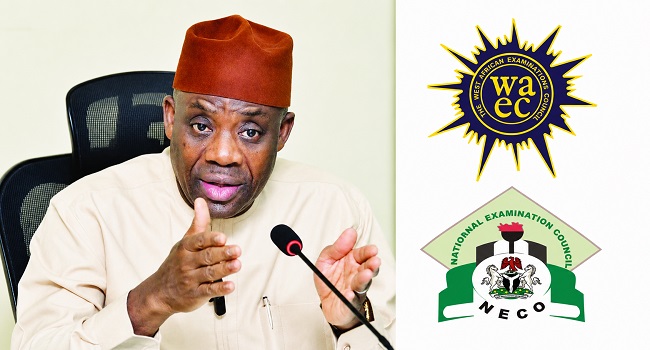

The Federal Government has suspended its proposed increase in registration fees for the 2027 West African Senior School Certificate Examination (WASSCE) and the National Examinations Council Senior School Certificate Examination (NECO SSCE), following widespread public concerns.
In a statement issued on Monday, the Federal Ministry of Education announced that it had withdrawn its June 18, 2026 letter proposing the fee adjustment to allow for a comprehensive review and broader consultations with stakeholders.
The statement, signed by the ministry’s Director of Press and Public Relations, Folasade Boriowo, explained that the decision reflects the government’s commitment to transparent and inclusive policymaking.
According to the ministry, the proposed adjustment would have increased the registration fee for both WAEC and NECO examinations from ₦27,500 to ₦50,000 starting in 2027, representing an 82 percent increase.
The ministry noted that the proposal was driven by the rising cost of administering public examinations, explaining that examination fees have remained largely unchanged for several years despite increasing operational expenses.
It identified growing costs in logistics, security, printing of examination materials, technology deployment, quality assurance, and other essential services as major factors placing financial pressure on examination bodies.
However, the Minister of Education, Dr. Maruf Tunji Alausa, has directed that implementation of the proposed increase be suspended pending consultations with relevant stakeholders.
“The proposal has been placed on hold in line with the Federal Government’s commitment to inclusive, transparent, and evidence-based policymaking,” the ministry stated.
The government emphasized that no increase in examination fees will take effect until consultations are completed and a final decision is reached.
The consultation process will involve examination bodies, state ministries of education, school owners and administrators, parents’ associations, organised labour, education stakeholders, and other relevant partners.
The ministry reiterated that policies affecting students and their families must undergo adequate public scrutiny and reflect the interests of Nigerians.
It also reaffirmed the Federal Government’s commitment to protecting students’ welfare, promoting equitable access to quality education, and ensuring responsible policymaking, while promising to keep the public informed throughout the consultation process before any final decision is made.