
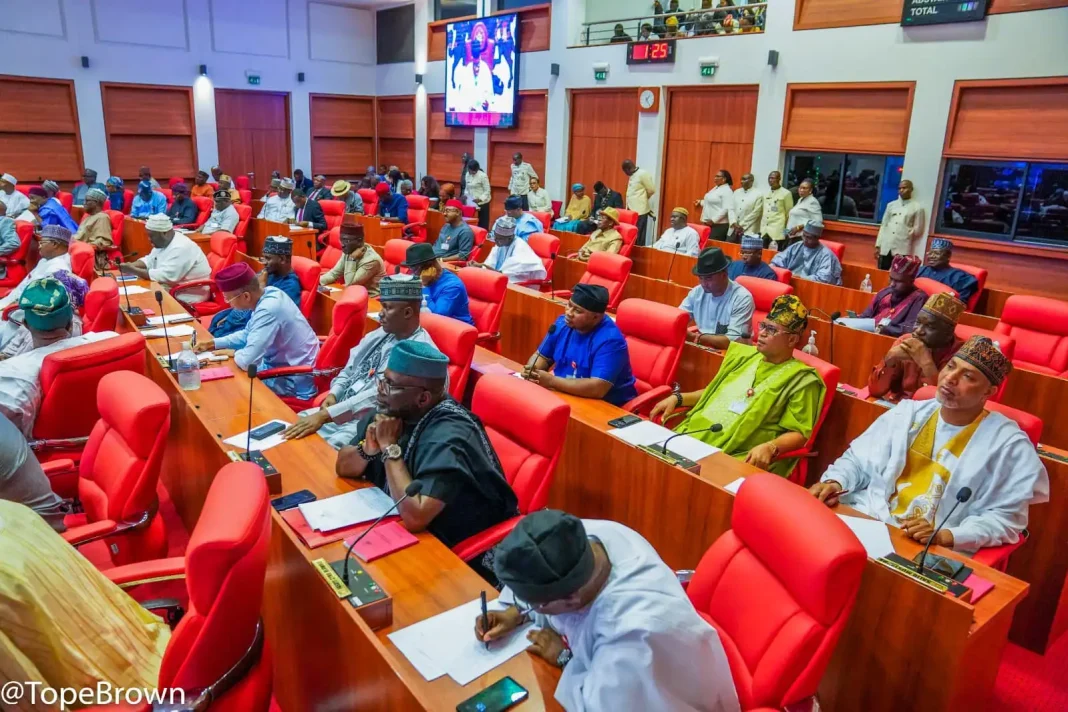

The Senate considered several major national issues during the week, including the killings of Nigerians in South Africa, the controversy surrounding an alleged non-existent government agency, proposed reforms to Nigeria’s secondary education system, criminal justice legislation, and the planned sale of Lafarge Africa Plc.
Senate Condemns Killings of Nigerians in South Africa
One of the major issues debated after the Senate resumed plenary was the recent wave of attacks on Nigerians living in South Africa.
The discussion followed a motion sponsored by Senator Asuquo Ekpenyong (Cross River South), who called on the Federal Government to pursue justice for Nigerians affected by the xenophobic attacks.
Several lawmakers, including Senators Wasiu Eshinlokun (Lagos Central), Adams Oshiomhole (Edo North), and Abdul Ningi (Bauchi Central), expressed concern over the continued killings of Nigerians and the destruction of their businesses and properties.
During the debate, Senator Eshinlokun proposed that the Federal Government should consider taking over the operations of MTN Nigeria and DStv as a way of compensating victims of the attacks. However, Deputy Senate President Barau Jibrin dismissed the suggestion, stating that Nigeria should first establish all the facts surrounding the incidents before considering any further action.
Senate Opposes Rehabilitation of Repentant Boko Haram Members
The Senate also urged the Federal Government to discontinue the policy of pardoning and reintegrating former Boko Haram members into society.
The resolution followed a motion presented by Senator Abdulaziz Yar’Adua (Katsina Central) after the killing of retired Major-General Rabe Abubakar, a former Defence spokesperson, and other military officers by bandits.
Lawmakers adopted the resolution through a voice vote, stressing the need for stronger security measures and accountability in the fight against insurgency.
Senate Rejects Investigation into Alleged Illegal Government Agency
The controversy over the alleged inclusion of a non-existent government agency in the 2026 budget resurfaced during Wednesday’s plenary.
A motion by Senator Kawu Sumaila (Kano South), seeking an investigation into the matter, failed to secure Senate approval after it was rejected through a majority voice vote.
Senator Sumaila argued that because the National Assembly approved the 2026 Appropriation Act, lawmakers had a responsibility to investigate how funding was allocated to an agency whose legal status had been questioned.
Following the plenary, Senate spokesperson Senator Yemi Adaramodu maintained that the National Assembly neither recommended nor inserted the ₦1.3 billion allocation linked to the agency. He added that lawmakers are not constitutionally responsible for verifying the background or legal status of agencies before appointments or budget submissions.
Bill Seeks Reform of Nigeria’s Secondary Education System
On Thursday, Senate President Godswill Akpabio announced the receipt of a bill from President Bola Tinubu aimed at restructuring Nigeria’s secondary education system.
The proposed legislation seeks to establish a comprehensive legal framework for reforms in secondary education nationwide.
The bill was referred to the Senate Committee on Rules and Business, with a directive to present its report within one week.
Executive Bill Targets Criminal Justice Reform
The Senate also received another executive bill seeking to repeal the Administration of Criminal Justice Act (ACJA) 2015 and replace it with the Administration of Criminal Justice Act 2026.
The proposed law aims to strengthen the administration of criminal justice in the Federal Capital Territory and federal courts across the country. It also provides for the establishment of an Administration of Criminal Justice Monitoring Council to improve the implementation and oversight of criminal justice processes.
Senate Approves Sale of Lafarge Africa
The Senate approved the proposed sale of Lafarge Africa Plc to Chinese investment firm Hainan Huaxin Pan-African Investment Company Plc.
Despite the approval, several lawmakers raised concerns over the transparency of the transaction, particularly regarding the identities of the company’s major shareholders.
According to the Senate ad hoc committee that reviewed the deal, Lafarge Africa plans to transfer its 18 percent market share to Huaxin, while Nigerian public investors currently own approximately 16.19 percent of the company.
Overview
The week’s Senate proceedings focused on national security, public accountability, education, justice sector reform, and investment. Lawmakers debated measures to protect Nigerians abroad, strengthen internal security, improve transparency in public finance, reform secondary education, modernise the criminal justice system, and review major corporate transactions affecting the country’s economy.