
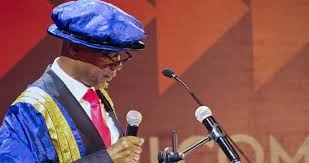

Newly installed Pro-Chancellor of Miva Open University, Tunji Olowolafe, has called for a fundamental transformation of Nigeria’s higher education system, stressing that quality education should be accessible to everyone regardless of location, financial status, or social background.
Speaking at the university’s maiden convocation ceremony in Lagos, Olowolafe described open and distance learning as a powerful solution to expanding educational opportunities while maintaining high academic standards.
According to him, the future of education lies in creating flexible learning systems that adapt to students’ realities rather than forcing learners to fit into outdated educational structures.
“Democratizing education does not mean lowering standards. It means ensuring that the conditions of learning do not become barriers to the quality of learning,” he said.
Olowolafe noted that modern education must embrace technology-driven solutions that allow students to access learning opportunities regardless of their circumstances.
Drawing inspiration from the educational vision of Obafemi Awolowo, who championed free education and educational broadcasting, he described Miva Open University as a modern continuation of efforts to make education more inclusive and accessible.
“Where the student cannot travel to the classroom, the classroom must learn to travel to the student,” he stated.
The education advocate challenged the long-held perception that open and distance learning is inferior to conventional university education, arguing that such misconceptions have limited investment in a system capable of bridging Africa’s educational access gap.
He emphasized that graduates of the institution have undergone rigorous academic training and should be proud of their achievements.
Addressing the graduating students, Olowolafe encouraged them to embrace lifelong learning and continue developing their skills beyond the classroom.
“The credential certifies that you can learn. The real test is whether you keep learning deliberately and consistently, without waiting for an institution to organise it for you.”
He concluded by urging graduates to become ambassadors of innovation, lifelong learning, and educational inclusion, as Nigeria seeks new ways to expand access to quality higher education in the digital age.