

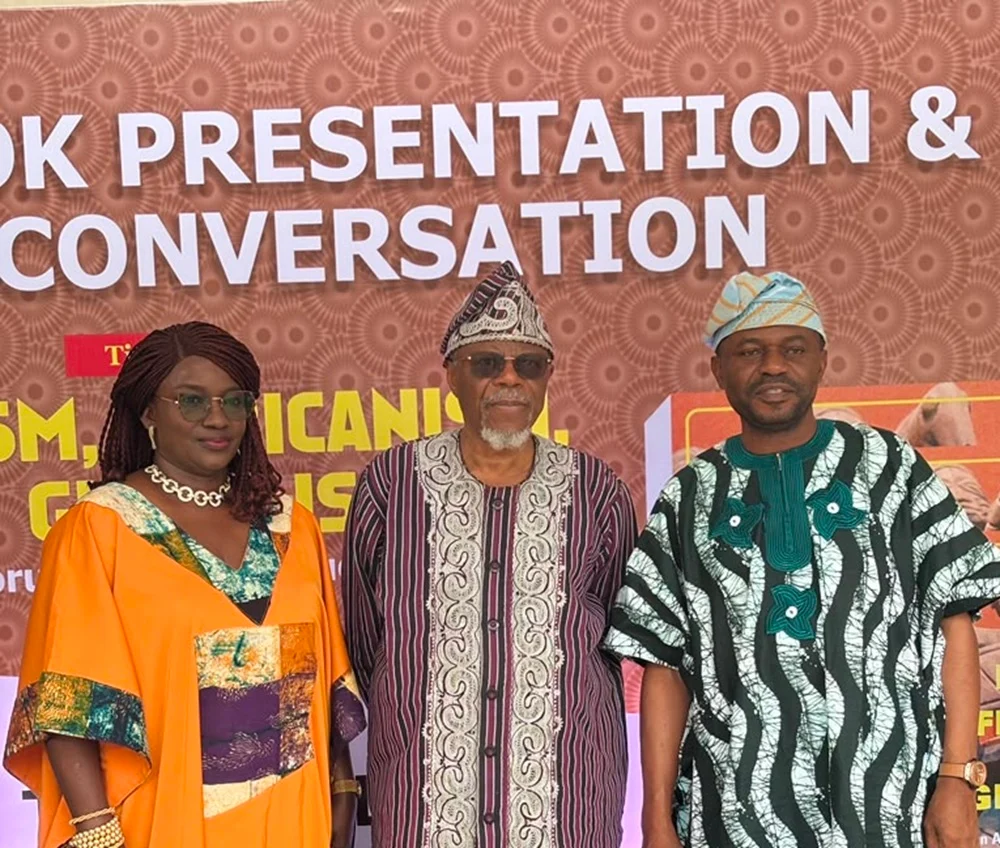

Renowned historian and scholar Professor Toyin Falola has called on universities and research institutions across Africa to give greater recognition to women scholars by documenting their work, citing their research, and promoting them to positions of academic leadership.
Falola made the call on Wednesday during the presentation of his latest book, Feminism, Africanism, and Globalism: Doyin Aguoru’s Voices through Drama, held at the Senator Abiola Ajimobi Resource Centre (International Conference Centre), University of Ibadan.
Using Professor Doyin Aguoru as a case study, Falola said African academia must move beyond symbolic praise and provide women scholars with the recognition their intellectual contributions deserve.
Speaking with journalists after the event, he noted that although women have made significant contributions to scholarship in Nigeria and across Africa, their achievements remain underappreciated.
According to him, women’s research is often inadequately cited, poorly documented, and celebrated less than that of their male counterparts.
Falola also highlighted several barriers that continue to limit the visibility and influence of women in academia, including limited access to research funding, editorial opportunities, professional networks, leadership positions, and prestigious academic awards.
He argued that these challenges have contributed to the underrepresentation of women in Africa’s intellectual history despite their contributions to fields such as literature, history, politics, development, and the humanities.
The historian explained that his latest publication was not only intended to celebrate Professor Aguoru but also to address the historical imbalance in recognising the work of African women scholars.
He described Aguoru’s academic career as an example of intellectual excellence that deserves sustained scholarly engagement rather than token recognition.
Falola urged universities to institutionalise meaningful support for accomplished women academics through deliberate citation of their publications, inclusion of their works in university curricula, invitations to deliver keynote lectures, appointments to leadership positions, funded research collaborations, and nominations for academic awards.
He stressed that women scholars should be recognised while they are still actively contributing to research and teaching rather than waiting until retirement or after their death.
According to him, documenting the work of women scholars while they remain intellectually active strengthens African scholarship and provides younger generations with role models in academia.
Falola said his decision to dedicate an entire scholarly monograph to Professor Aguoru was influenced by the originality of her work, particularly her contributions to African feminism, drama, performance studies, identity, culture, and social justice.
He noted that Aguoru’s writings offer important insights into contemporary African society by addressing issues such as patriarchy, gender inequality, harmful cultural practices, and social justice while presenting alternative visions for societal transformation.
Falola maintained that recognising women scholars is essential to building a more inclusive and balanced body of African knowledge.
The book presentation attracted leading academics, traditional rulers, literary critics, researchers, and students from across Nigeria. The event featured goodwill messages, musical performances, dramatic presentations, scholarly reviews, and the formal unveiling of the publication.
Reviewers described the book as a valuable contribution to African literary criticism, noting that it not only examines Professor Aguoru’s works but also situates her scholarship within broader discussions on African feminism, performance studies, identity, culture, and global intellectual discourse.
Responding, Professor Doyin Aguoru described the publication as one of the greatest honours of her academic career.
She expressed gratitude to Professor Falola for using her scholarship to highlight the contributions of African women intellectuals.
Aguoru said the recognition represented not only a personal achievement but also a tribute to generations of women who have dedicated their lives to teaching, research, creativity, and nation-building.
She also encouraged universities across Africa to create academic environments where women can thrive through merit, equal opportunity, and rigorous scholarship.
“I hope this moment encourages every young woman in academia to believe that excellence is worth pursuing and that her voice matters,” she said. “Let us continue to build institutions where scholarship is judged by its quality, originality, and impact—not by gender.”