

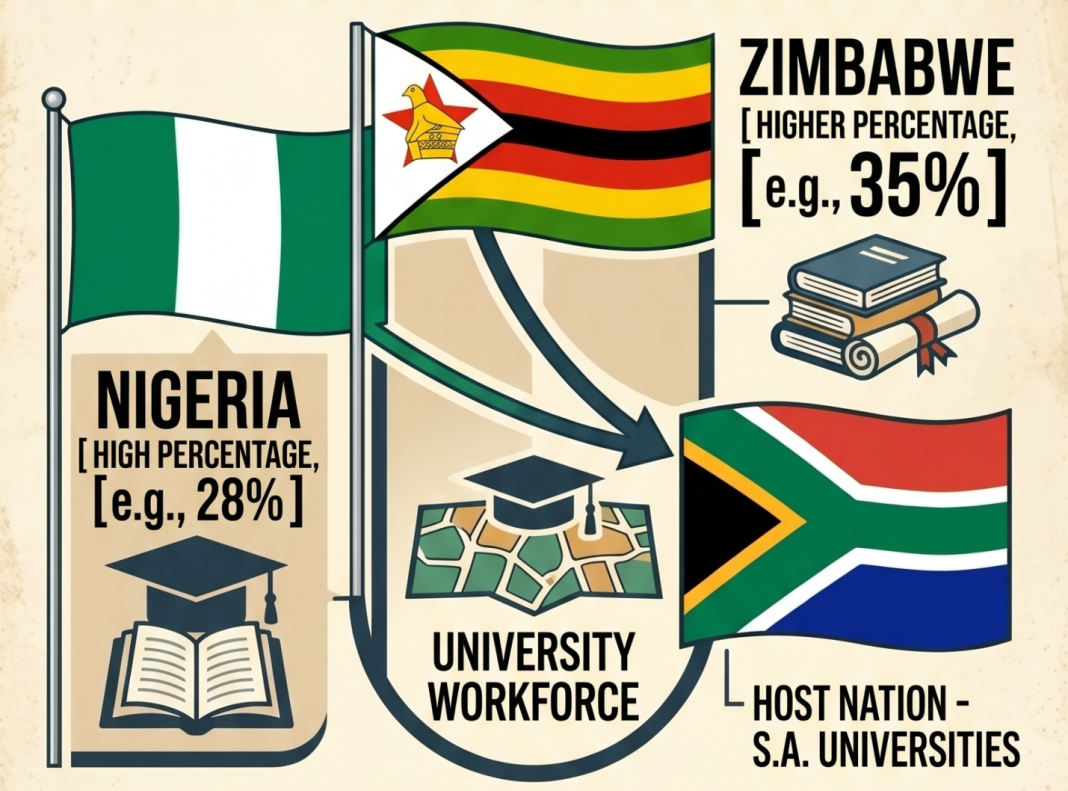

Zimbabwean and Nigerian academics make up more than 40 per cent of foreign lecturers and researchers employed in South Africa’s public universities, according to newly released figures from the country’s higher education authorities.
The data, made public by independent platform Truth Panther, shows that South African public universities employed over 7,000 foreign academics as of 2025. Zimbabweans accounted for 27 per cent of this workforce, while Nigerians made up 14 per cent, bringing the combined total to 41 per cent.
The report, which cited documents obtained through South Africa’s Parliamentary Portfolio Committee on Higher Education and Training, highlights the growing presence of African professionals in the country’s academic sector amid ongoing debates around immigration and xenophobia.

In a post on X, Truth Panther stated it had received detailed records showing the distribution of foreign academics across public universities. It also noted that the University of Johannesburg recorded the highest number of foreign staff, with more than 1,400 academics, followed by the University of the Witwatersrand and the University of Cape Town.
The platform credited the committee’s chairperson, Hon. Tebogo Tebzinho Letsie, for facilitating access to the data, adding that the figures reflect steady growth in foreign academic employment—from 6,739 in 2024 to 7,026 in 2025.
Institutional breakdown shows that several leading universities host significant numbers of foreign academics, including the University of Pretoria, North-West University, the University of the Free State, Stellenbosch University, and the University of KwaZulu-Natal.
The findings are expected to reignite discussions on immigration, labour demand, and skills shortages in South Africa, where foreign professionals often fill critical gaps in higher education, healthcare, and technology sectors.
For years, Nigerian and other African migrants in South Africa have raised concerns over discrimination and xenophobic violence, despite their contributions to academia and the broader economy.
Past outbreaks of xenophobic attacks—particularly in 2008 and 2019—led to deaths, displacement, and diplomatic tensions between South Africa and several African countries, including Nigeria.
While full nationality breakdowns are yet to be officially published, the current data underscores the significant role played by Zimbabwean and Nigerian academics in sustaining South Africa’s university system and advancing research output in the region.