
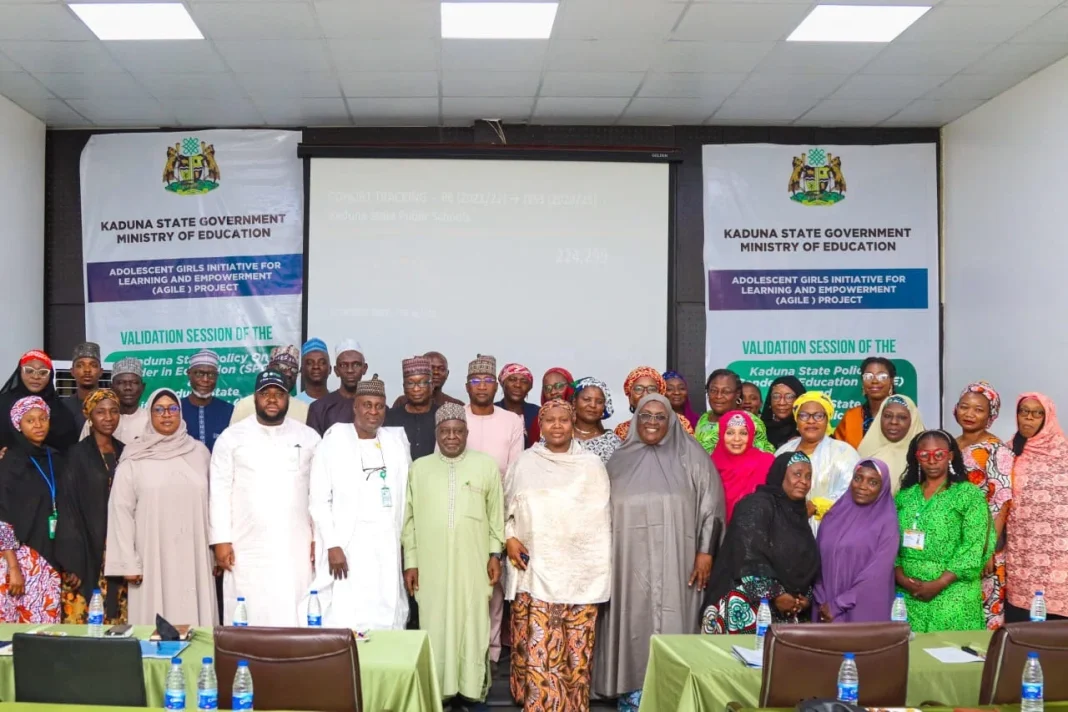

The Kaduna State Government, in collaboration with key stakeholders, has validated draft Gender in Education and Life Skills Policies aimed at fostering inclusive, equitable, and well-rounded learning across the state.
The validation workshop, held in Kaduna, convened education experts, government officials, development partners, and civil society organisations to review and refine the policy documents ahead of their final adoption.
Speaking at the event, the Commissioner for Education, Prof. Abubakar Sani, said the policies were crafted to address long-standing systemic challenges in the education sector while improving access, participation, and learning outcomes for all.
He explained that the Gender in Education Policy specifically targets inequalities that continue to limit educational opportunities especially for girls and other vulnerable groups. According to him, the framework prioritises safety, fairness, and inclusivity within schools.
Prof. Sani highlighted a key innovation in the policy: its development is based on detailed, Local Government Area (LGA)-specific education analyses, moving away from the traditional “one-size-fits-all” model.
“This is the first time a Nigerian state has conducted a comprehensive analysis of the unique educational realities, opportunities, and resources across all its 23 LGAs to guide policy formulation,” he said.
On the other hand, the Life Skills Policy is designed to equip learners with essential competencies beyond academic knowledge. These include critical thinking, communication, resilience, and decision-making skills necessary for success in a rapidly evolving world.
The commissioner described the validation process as a crucial step, noting that contributions from stakeholders would ensure the policies are practical, inclusive, and responsive to real-life challenges.
During a panel session, the Permanent Secretary of the Ministry of Internal Security and Home Affairs, Malam Bashir Muhammad, said the Life Skills Policy introduces a shift in the education curriculum by integrating entrepreneurial skills as core learning components.
He noted that while multiple development partners have supported education initiatives in Kaduna, their efforts have often been fragmented, underscoring the need for a unified policy framework to streamline interventions.
“We have taken full ownership of these initiatives. The policy includes strong institutional and implementation frameworks to ensure sustainability, even without external partners,” he said.
He added that implementation plans have been incorporated into the state budget and supported by operational and sector-wide strategies.
Also speaking, the Director of Planning at the Ministry of Education, Salisu Baba-Lawal, assured that the policies would undergo continuous review to monitor progress and address emerging challenges.
Stakeholders at the workshop emphasised that improving school enrolment, retention, and completion particularly among girls would help tackle pressing social issues such as child marriage, teenage pregnancy, and gender-based violence.
Executive Director of the Centre for Girls’ Education, Habiba Mohammed, stressed that combining education with life skills empowers girls to make informed decisions and build confidence.
“When girls are educated and equipped with life skills, they are better positioned to resist harmful practices and contribute meaningfully to society,” she said.
Similarly, Maryam Dangaji, Kaduna State Coordinator of the Adolescent Girls Initiative for Learning and Empowerment (AGILE), noted that effective implementation of the policies would address barriers such as early marriage and school dropout among girls.
She explained that a core objective of the Life Skills Policy is to ensure that every girl-child enrols in school, progresses through each level, and completes secondary education successfully.
Other stakeholders, including representatives of the Reaching Out-of-School Children project, also underscored the importance of the policies in promoting equal access to education for all children and adolescents in the state.