

At dawn in Maroua, a steady stream of young people make their way to the École Normale d’Instituteurs de l’Enseignement Technique (ENIET) – the teacher training college for technical education. In this corner of Cameroon’s Far North region, burdened by deep educational and economic challenges, these students arrive each morning driven by a shared ambition: to build a future worth having.
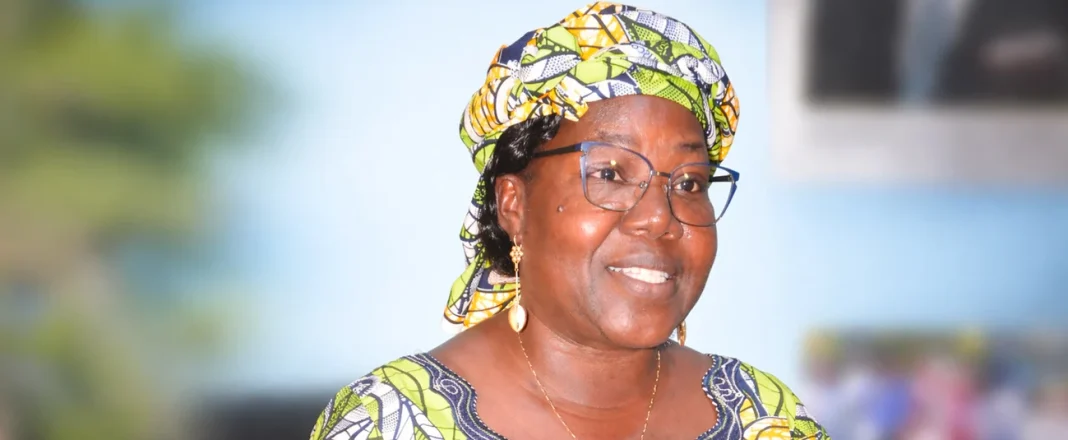
Since 2021, the institution – home to hundreds of young Cameroonian learners – has been led by a woman of uncommon resolve: Florence Djaoyang. Under the 52-year-old’s stewardship, the school does far more than impart skills – it shapes individuals capable of passing on knowledge, igniting ambition in others and driving change.
In a region where access to quality education remains a pressing challenge, Djaoyang has devoted herself to forging a new generation of technical teachers – men and women who will, in turn, become agents of social transformation.
“Being a woman in leadership is about showing the way and encouraging the young,” she says. That morning, she is dressed in an elegant wax-print ensemble in yellow, blue and green, offset by a carefully tied matching headscarf. On the shelves beside her desk, a collection of sports trophies speaks to the achievements of her students in inter-school competitions. “The children are truly talented,” she adds, her eyes bright with pride.
Her dedication has not gone unnoticed. In 2023, she was awarded the distinction of Officer of the Palmes Académiques – one of the highest honours in education in Cameroon. Yet her ascent has been anything but accidental. Since beginning her career in 1998, Florence Djaoyang has steadily risen through the ranks of the country’s education system. From teaching at Maroua’s secondary technical school to serving as an inspector and pedagogical coordinator in technical education, she has built a wealth of experience shaped by years in the field.
Leadership, it seems, was always her calling. Raised in a family of teachers and education specialists, she set her course early. Her ambition has remained constant: to inspire through education, and to contribute to the independence and empowerment of the young women of her region.
“For me, it began as a passion” she recalls. “At secondary school, I was already organising study groups with my classmates. I was always encouraging others – especially the girls – not to give up on their education.”
That determination has never left her. “In student associations, I liked taking on responsibilities, to set an example for other young women and urge them to fight for themselves. I often tell them: you have to learn to push beyond your limits, believe in your abilities, and strive for excellence.”
Today, Florence heads the École Normale d’Instituteurs de l’Enseignement Technique, an institution of 295 students, including 117 young women, spread across twelve vocational streams – accountancy, office administration, electrical engineering, industrial maintenance, crop production, beauty therapy, hairdressing – all fully operational. Upon graduating, students will either be posted to technical secondary schools or strike out on their own as entrepreneurs. “We have candidates in every stream,” Djaoyang notes.


Capacity building programme brings hope to young women and youth as education opens up opportunities
Yet leading such an institution in this part of Cameroon is no small undertaking. The Far North, home to 18 per cent of the national population, is served by just six per cent of the country’s technical schools and four per cent of its technical secondary teachers. Economic hardship, security concerns and deep social pressures weigh heavily on families here.
“Our main difficulties are the shortage of teachers in certain specialisms. In some streams, we don’t have a single instructor,” the director says, with concern. “We also lack workshops and equipment, which severely limits the standard of training we should be able to offer.”
Still, she remains resolutely optimistic. “We make do with what we have and try at the very least to acquire the essential tools so that students can practice their craft.” Her office is crowded with boxes of computers and teaching materials. She keeps them there, she explains, to manage them more effectively – “because there is so little”. Each year, the school acquires a small amount of equipment to keep things running. “As you can see, my office is rather cluttered – we store some of the tools students use for practical work here. These computers, for instance, were delivered this morning for three workshops,” she says, gesturing towards the boxes.
This ability to press on despite constraints is perhaps the most powerful lesson in leadership she imparts to her students – particularly the 117 young girls who look to her as a role model.

For her, being a woman leader in vocational education is not a title to be worn lightly. It is a responsibility that demands leading by example.
“When you are trained, you can be useful in a company, teach, or pass your knowledge on to the young people who will follow in your footsteps,” she explains.
She has high hopes for the future of her institution, ambitions she believes may soon be realised through the programme “Building Capacity and Skills for Employability and Entrepreneurship in Cameroon’s Far North” (CAP2E). Funded to the tune of 89.2 billion CFA francs by the African Development Bank, the programme was officially launched on 20 February 2026 by Cameroonian authorities and representatives of the Bank Group. The school is among its future beneficiaries.

” We are eagerly awaiting this programme. It will improve our infrastructure, allow the workshops to function properly, and give students far more hands-on practice. It will also support the production and marketing of goods made in the workshops, which will help the school fund some of its own activities.”
The CAP2E programme aims to strengthen technical and vocational training institutions, improve the employability of young people and better meet the needs of the private sector. It also supports entrepreneurship – with a particular focus on women and youth – while modernising educational and health facilities across the region.

To all the young women who doubt their own potential, Florence Djaoyang offers this counsel: “Have confidence in yourselves, and love what you do. Don’t pursue your studies to please someone else, pursue them to reach your own goals. Go as far as you possibly can, so that one day you can serve your country.”
Credit_African Development Bank Group