

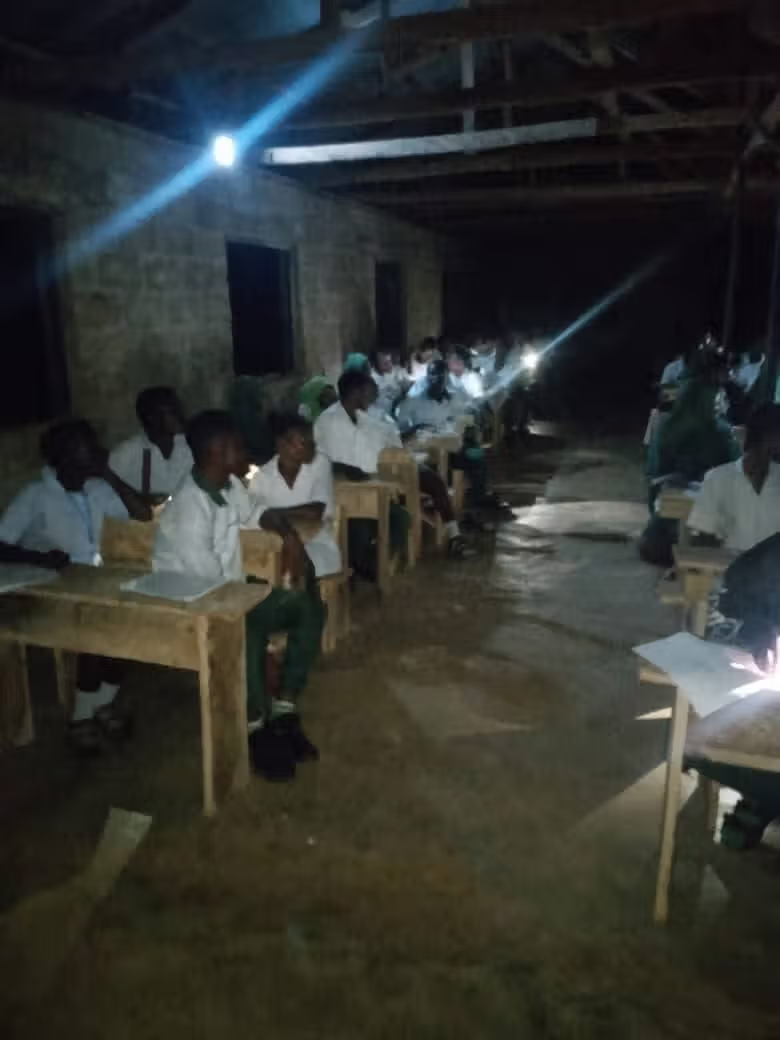

The conduct of the 2026 West African Senior School Certificate Examination (WASSCE) has sparked widespread condemnation after hundreds of candidates across Oyo, Lagos, Ogun, and Osun states were reportedly forced to sit for examinations late into the night, with some relying on torchlights, phone flashlights, and solar lamps to complete their papers.
The controversy followed the late arrival of examination materials at several centres, causing hours-long delays that disrupted scheduled examination timetables and left students stranded at their centres well after dark.
Reports indicated that candidates writing Physics on Monday endured long waits before sitting for the Essay and Objective papers originally slated for 2:00 p.m. and 3:30 p.m. respectively.
The situation worsened on Wednesday when the General Mathematics Objective paper reportedly commenced as late as 6:30 p.m. in some centres and around 8:30 p.m. in others, forcing candidates to finish their examinations after 10:00 p.m.
In Oyo State, particularly in Ibadan, the delays reached alarming levels. The first batch of the Agricultural Science Practical examination, scheduled for 2:00 p.m., and the second batch, fixed for 3:30 p.m., had yet to begin in some centres as of 8:00 p.m.
As darkness set in, students were left with no option but to write under poor lighting conditions. Videos circulating on social media showed candidates struggling through their examinations with torchlights, mobile phone flashlights, and solar-powered lamps.
The incident has triggered a wave of criticism from parents, students, and concerned Nigerians on social media.
One X user, Mariam Kehinde, expressed concern over the safety of her younger sister, who remained at her examination centre late into the evening.
“My sister left for her WAEC exam in the morning and still had not returned home by past 8 p.m. She called around 6 p.m. to say their examination papers had only just arrived,” she lamented.
Another user, Adedeji Adeyinka, described the situation as a major failure in examination administration, revealing that candidates writing Government were forced to wait over four hours for the Objective paper after completing the Theory section.
He further noted that Agricultural Science Practical examinations scheduled for 2:00 p.m. did not commence until about 9:00 p.m. in many parts of Oyo State.
Several other candidates and parents complained about shortages of question papers. One user alleged that only 35 Mathematics question papers were supplied for 75 candidates, while another reported that a hall containing about 250 students received only 120 copies of the examination booklet.
Others claimed that schools with over 130 candidates received as few as 16 question booklets, forcing students to share materials while waiting for additional copies.
The delays have also raised serious security concerns, particularly as candidates were kept at examination centres late into the night amid growing fears over kidnapping and other criminal activities.
Responding to the incident, the Head of Public Affairs of WAEC Nigeria, Moyosola Adesina, said the examination body would issue an official statement addressing the complaints.
Meanwhile, the President of the National Association of Nigerian Students (NANS), Akinteye Azeez, condemned the development, describing it as both dangerous and unacceptable.
According to him, students who had spent months preparing for the examinations should not be subjected to unnecessary hardship due to logistical failures.
“It is appalling that candidates were kept at examination centres beyond reasonable hours. No administrative challenge should compromise the safety, welfare, and rights of students,” he stated.
Azeez noted that the situation was particularly troubling given the security challenges facing parts of the South-West region, warning that leaving students stranded at examination centres late into the night exposed them to unnecessary risks.
He called on WAEC to urgently review its logistics and contingency plans to prevent future occurrences, stressing that students must never become victims of poor planning or institutional negligence.
The 2026 WASSCE commenced on April 21 and is expected to conclude on June 19.