

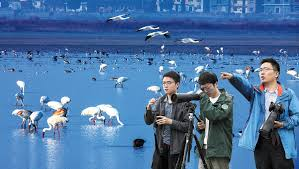

As China’s annual Spring Festival travel rush winds down, another mass migration is about to begin at Poyang Lake, the country’s largest freshwater lake.
More than 700,000 migratory birds gathered there are preparing to head north in March.
For 61-year-old Wang Xiaolong, this seasonal rhythm has defined four decades of work.
Wang has spent 40 years protecting birds at the lake in east China’s Jiangxi Province.
Each morning, he patrols wetlands in camouflage and boots, scanning the horizon with practised eyes.
Poyang Lake serves as a critical wintering and stopover site along the East Asian–Australasian Flyway.
Covering up to 4,000 square kilometres, it hosts more than 700,000 wintering birds annually, including the world’s largest wintering population of Siberian cranes.
Since retiring from military service at 21 and joining the local nature reserve administration, Wang estimated that he had walked over 400,000 kilometres on patrol.
It’s roughly equivalent to circling the globe 10 times.
For more than 14,000 days, he has rescued and released more than 300 injured birds.
Recently, Wang responded to reports of an injured oriental white stork with a broken wing.
The bird is now recovering at a rescue station designed to replicate natural wetland conditions.
Plans are underway to expand the facility into a 1,600-square-meter standardised rescue centre, complete with an operating room and rehabilitation enclosures.
Conservation efforts increasingly rely on both public engagement and technology.
In recent years, Wang has delivered lectures in schools and lakeside villages, encouraging ecological awareness.
Meanwhile, an integrated monitoring network combining high-definition cameras, drones and ground patrols now tracks bird activity in real time.
Scientific surveys show the number of bird species recorded in the reserve has risen from 381 to 394, including dozens of nationally protected species, a sign, conservationists say, of improving biodiversity.
“This is a march without a finish line. As long as I can move, I will stay here and guard them,” Wang said NAN
credit_Real News