
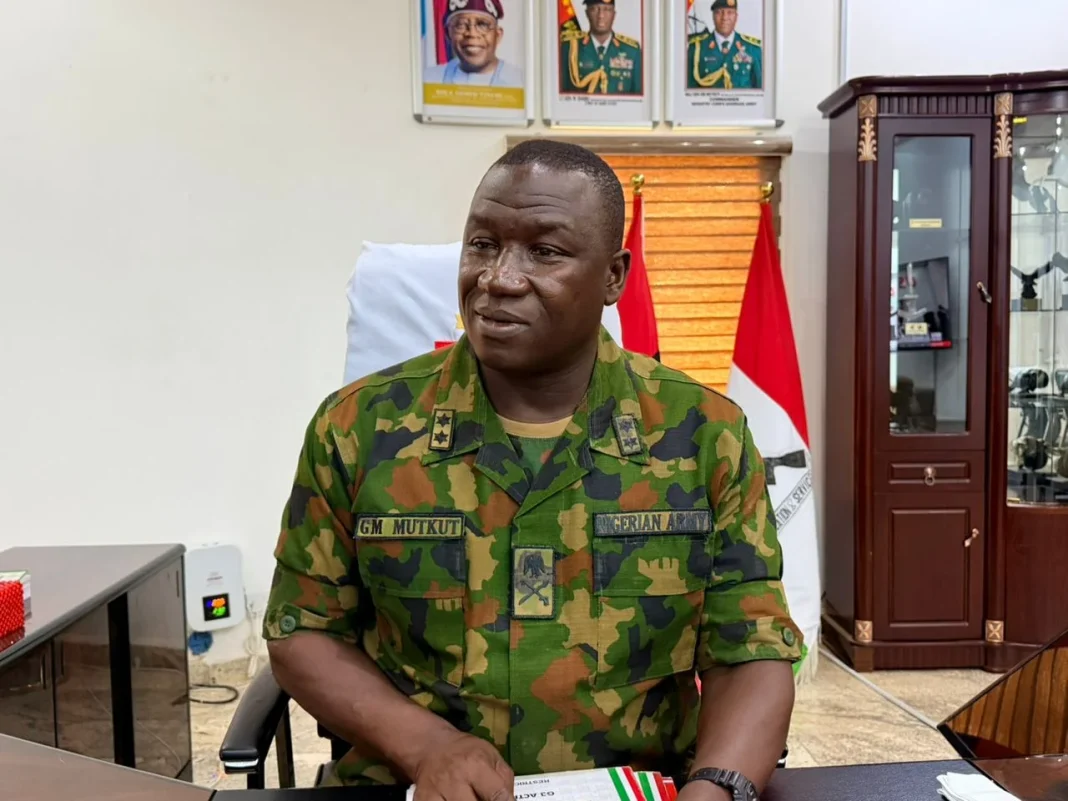

The Commander of the Infantry Corps of the Nigerian Army, Major General Godwin Mutkut, has called for a comprehensive multinational strategy involving countries within the Lake Chad Basin and the wider Sahel region to effectively combat terrorism, insurgency, and other cross-border security threats.
Speaking on the persistent insurgency in Nigeria’s North-East, Mutkut stressed that military operations alone cannot permanently eliminate terrorism without sustained investments in education, economic development, and regional cooperation.
According to the senior military officer, one of the key factors fueling terrorism across the Lake Chad Basin is the widespread lack of education and limited access to economic opportunities in vulnerable communities.
He noted that many communities in Northern Borno, particularly those around the Lake Chad Basin, have for decades faced inadequate educational infrastructure and minimal government presence, creating conditions that extremist groups exploit to recruit followers and spread radical ideologies.
“Where people lack access to education and information, they become more vulnerable to manipulation and extremist narratives,” Mutkut said. “Addressing educational deficits must remain a critical component of any long-term counterterrorism strategy.”
Why Terrorists Are Attracted to Lake Chad
The General identified local government areas such as Abadam, Marte, Kukawa, and Guzamala as strategically significant in the fight against insurgency due to their geographical location and abundant natural resources.
Despite years of insecurity, he described the Lake Chad Basin as one of the most economically productive regions in Nigeria, with fertile agricultural land, thriving livestock production, and a lucrative fishing industry.
“The Lake Chad Basin is naturally endowed with enormous resources,” he explained. “Crops such as onions, pepper, and vegetables can be cultivated throughout the year because of the rich soil and constant availability of water.”
Mutkut noted that the abundance of food, pasture, and economic opportunities has made the area attractive not only to local communities but also to terrorist groups seeking sustainable bases of operation.
He further highlighted the economic appeal of fishing around communities such as Baga, describing it as one of the most profitable industries in the region.
“The fishing industry around Lake Chad is extremely lucrative. For many young people, fishing provides immediate financial returns that seem more attractive than spending years in school,” he said.
According to him, this economic reality often makes it difficult to convince young people that formal education offers greater long-term benefits.
Education Still Faces Major Challenges
Mutkut acknowledged efforts by governments and development partners to promote education in the region through incentive-based programmes.
He recalled initiatives that linked educational attainment to access to fishing equipment, including boats, engines, and nets, aimed at encouraging school enrollment.
However, he observed that many youths still choose immediate income opportunities over formal education, posing a challenge to long-term development efforts.
Geography Complicates Security Operations
The Infantry Corps Commander also described the Lake Chad Basin as one of the most difficult operational environments for security forces.
According to him, the lake contains hundreds of islands that serve as natural hideouts for terrorist groups. Seasonal changes in water levels frequently alter the landscape, making surveillance and military operations more complex.
“These islands provide concealment and natural cover that terrorist groups exploit to evade detection and sustain their operations,” he explained.
He added that dense vegetation and difficult terrain often hinder intelligence gathering and aerial surveillance, allowing insurgents to establish temporary camps, training grounds, and logistics hubs.
Terrorism Requires a Regional Response
Mutkut stressed that the insurgency challenge extends beyond Nigeria and affects neighbouring countries including Niger, Chad, and Cameroon.
“This is not a problem unique to Nigeria. The same challenges of poverty, inadequate education, underdevelopment, and insecurity exist across communities bordering Lake Chad,” he said.
Because the threat transcends national boundaries, he argued that the response must also be multinational.
The Army commander therefore called for deeper cooperation among member states of the Lake Chad Basin Commission and countries across the Sahel region through enhanced intelligence sharing, joint military operations, coordinated border security, and harmonised development programmes.
He said stronger collaboration would help security forces track terrorist movements, disrupt supply networks, and deny insurgents safe havens.
Development Key to Lasting Peace
Mutkut maintained that sustainable peace can only be achieved when military victories are backed by meaningful socio-economic development.
“Terrorism cannot be defeated solely through military force,” he stated. “Security operations are essential, but they must be supported by development initiatives that provide people with hope, opportunities, and alternatives to extremism.”
He called for increased investments in infrastructure, education, healthcare, and economic empowerment programmes across vulnerable communities.
Expressing optimism about ongoing regional security efforts, the General said stronger cooperation, improved governance, and sustained investments in human development could significantly weaken terrorist networks and restore stability across the Lake Chad Basin.
“The fight against terrorism is a collective responsibility. Countries of the Lake Chad Basin and the wider Sahel must continue to work together. With sustained cooperation, improved governance, education, and economic development, we can ultimately defeat terrorism and secure a more peaceful future for the region,” he said.